Java How to Read From Google Calendar
How to Use the Google Calendar API
Google Calendar is i of the most pop ways to manage events, meetings, holidays, and anything else y'all need to schedule. The Google Calendar API lets yous add and update events automatically, and then your computer manage your calendar for yous!
Here's everything you need to know well-nigh the Google Calendar API:
- How to Create Google Agenda Admission Tokens or API keys?
- How to Refresh Google Calendar Access Tokens Using Refresh Tokens?
- Example Google Agenda API Code
How to Go Started With the Google Agenda API?
There are three master ways ways to use the Google Agenda API:
Option 1: Google Agenda Official Customer Libraries
Google provides official libraries beyond many popular languages similar Java, Javascript, Python, PHP and more. A full listing of available client libraries can exist found on the Google Calendar documentation download page here . This may crave more installation steps.
How Do You lot Utilise the Official Client Library?
Here's an example of using the Google Calendar official Python client library:
from googleapiclient.discovery import build from oauth2client import file , client credentials = client . AccessTokenCredentials ( 'ACCESS_TOKEN' , 'USER_AGENT' ) service = build ( 'calendar' , 'v3' , credentials = credentials ) calendars = service . calendarList () . list () . execute ()
When Should I Use the Official Client Libraries?
If you are a developer with control over your environment (and particularly tin can install new libraries), the official libraries will make it far quicker to kickoff using the Google Calendar API.If you need more circuitous logging, or already have powerful HTTP client integration, y'all might prefer the Native HTTP APIs.
Estimated time to build a basic integration with the official client libraries: 12 hours.
Selection two: Native Google Calendar HTTP APIs
Most programming languages provide HTTP clients that you can employ to make your own HTTP calls to the API. In fact, the official customer libraries often use them behind the scenes. Yous'll have to set your ain API key, headers, and other HTTP settings which tin can be cumbersome, but unremarkably that is a very routine task. Once you write code to make a single API phone call, you tin reuse it for afterwards API calls.
How Practise You lot Use Google Calendar'south Native HTTP API?
Here's an example of using Google Agenda's native HTTP API in Python using the pop requests library, it grabs a list of calendars in your account:
import requests response = requests . get ( url = 'https://www.googleapis.com/calendar/v3/users/me/calendarList' , headers = { 'Potency' : 'Bearer ACCESS_TOKEN' }, ) response . raise_for_status () calendars = response . json () . become ( 'items' )
When Should I Use the Native HTTP API?
If you are a programmer and are comfortable with your programming language's standard library HTTP customer, or have a favorite HTTP customer in listen, the native HTTP API might provide a better experience. If yous accept other special needs like logging, HTTP proxies, and asynchronousness, the native HTTP API may be the only option that let you customize Google Agenda's API calls to piece of work the way you demand.
Estimated time to build a basic integration with the native HTTP APIs: 15 hours.
Option 3: Use Zapier
Whether you're a developer or non, Zapier's app integration platform can oft practice much of what the official client libraries or native HTTP APIs can practise—without needing to write code. Zapier is an easy-to-use UI to build workflows that seamlessly comprise information from other APIs and services. You tin apply Google Calendar's core API calls through Zapier with 1,300+ other APIs—perfect for workflows between popular SaaS services. Hither are some pop examples:
How Practice You Utilize Google Calendar's API With Zapier?
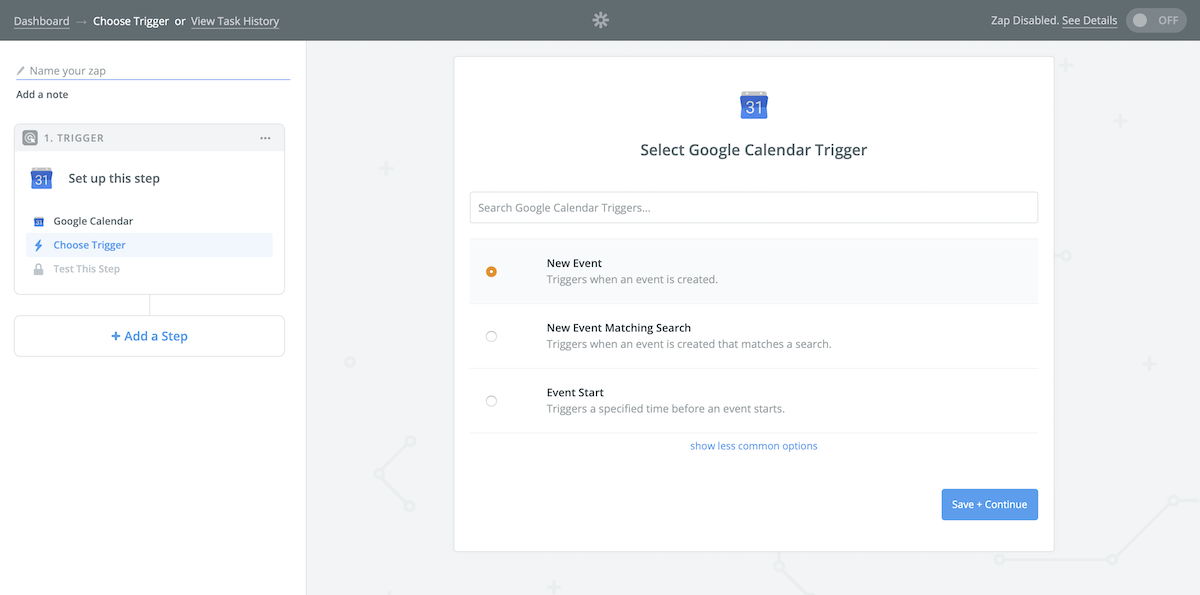
Zapier makes it easy to utilise Google Agenda's API. Connect your Google Agenda account to Zapier using Google'south OAuth-powered authentication, then y'all can select from triggers or deportment to sentinel Google Calendar for new information or find and create information in Google Calendar.
When should I use Zapier instead of the APIs?
Generally speaking, it tin can exist both time and cost constructive to employ Zapier to create Google Agenda automations instead of writing them yourselves. Zapier allows for deep customizability and flexibility, with thousands of popular integrations, filters and formatters to get the data yous need, and tools to add Python or Javascript lawmaking to your workflows
The fourth dimension savings is particularly noticeable if you lot demand to integrate multiple APIs with their own idiosyncrasies. It's additionally helpful if others on your squad might need to change the automation later, peculiarly colleagues who are not developers. You won't have to maintain the integration, either—if Google Calendar changes their API calls, Zapier'due south team volition keep its integrations updated and so your workflows volition keep working. Zapier makes sharing and maintenance of your API-powered workflows a cakewalk.
Estimated fourth dimension to build a basic integration with Zapier: 10 minutes.
→ Endeavor Zapier with Google Calendar for gratis!
How to Create Google Calendar Access Tokens or API keys?
How to Create a Temporary Google Agenda Access Token
Desire to test out using the Google Calendar API? Y'all tin can use the Google OAuth ii.0 Playground to create access tokens that just piece of work for an hour which is useful for initial testing without going through all the steps to create a project (which can be complicated).
Start, select the API you lot want access to. In this case, we simply demand Agenda access:

Second, y'all'll click Authorize APIs, yous'll be redirected to an approving screen. Choose your account, so click let and go along. Next, you'll desire to exchange the Authorisation code for access and refresh tokens:

Thirdly, at present you should see provided access tokens and refresh tokens:

Finally, you'll see this admission token starts with abc1..., and so let's copy that! Unfortunately, we take no use for this particular refresh token (since yous exercise not have Google's own client_secret, it cannot be used exterior of this tool).
Important! These only work for an hr, so this is only for testing / playing around. Y'all must repeat these steps to get a new access token every hour.
How to Create a Full Google Agenda Access Token?
Creating a total Google Agenda access token is a bit more complicated, merely is required if you desire to build a full project with Google Calendar's API.
Offset, create a project within Google'due south Cloud dashboard. If you already have a project, you lot tin can skip this part and use the existing project:


2nd, once you are in your projection, get the dashboard and click the Enable APIs push:

Third, search for Google Calendar and enable it if you oasis't already:


Fourth, once it is enabled, create the 'OAuth Client ID' credential from the left sidebar:


Fifth, you volition likely need to configure your consent screen, and so make sure to give it a descriptive name and select Google Calendar for the scopes:


6th, now y'all'll be able to finalize your client, choose 'Web Application' for Awarding Type and be sure to give it a descriptive proper name similar 'My Calendar Customer':

Finally, yous'll exist given a 'Client ID' and 'Client Secret', continue those handy for the next steps!
You lot now take two options and which side by side stride you choose depends on your needs:
- Edifice an application for others: you lot'll need to get familiar with the standard Google OAuth flow. This will involved a web server and is just like building out any OAuth awarding.
- Building an application hardcoded for yourself: y'all tin use Google's OAuth 2.0 Playground to generate a refresh token with your ain application without additional web services. Read on to learn how!
A clever manner to get a personal admission token and refresh token click into your 'My Calendar Client' from the terminal step and add https://developers.google.com/oauthplayground to the 'Authorized redirect URIs':

Simply similar the 'Creating a Temporary Access Token' section, we're going to use the Google OAuth 2.0 Playground but nosotros're going to provide our ain 'Customer ID' and 'Client Clandestine' from before:

At present you tin follow the same steps as earlier to exchange for tokens, but this time take note of your refresh token! While your access token is yet only good for an 60 minutes, your refresh token is actually useful and you can utilise it to go a new access token.
How to Brand Your Get-go Google Calendar API Call?
You'll demand an
ACCESS_TOKENto complete this request!
To make your API telephone call, it is all-time to have stock of all the components you lot'll need to make that request. First we need our target (why are nosotros making the API call?), then we demand our authorization (how will we connect to our account via the API?), and finally need to call back about anything else the request might require (what data fields volition nosotros need from the API or should we ship to the API?).
Let's first with one of the simplest Google Calendar API calls yous can brand: Get Agenda settings. This is just to ensure our API key works properly:
- Method:
Go - URL:
https://www.googleapis.com/calendar/v3/users/me/settings - Querystring: none
- Headers:
-
Authorization: Bearer abc1.aBcDeFgHiJkLmNoPqRsTuVwXyZ0123456789aBc -
Content-Blazon: application/json - Body: not applicable for GET
Let'south endeavour this example of the official client libraries using Python Google'south google-api-python-client and oauth2client:
from googleapiclient.discovery import build from oauth2client import file , customer credentials = client . AccessTokenCredentials ( 'ACCESS_TOKEN' , 'my-calendar-bot/i.0' , ) service = build ( 'agenda' , 'v3' , credentials = credentials ) settings = service . settings () . listing () . execute () print ( settings )
Or, here'south an instance of the native REST API using Python and the pop requests library:
import requests response = requests . go ( url = 'https://www.googleapis.com/agenda/v3/users/me/settings' , headers = { 'Authorization' : 'Bearer ACCESS_TOKEN' , }, ) response . raise_for_status () print ( response . json ())
Prefer Javascript? Hither's an example of Google Calendar'southward native Residue API using Javascript and the popular fetch function:
var fetch = require ( "node-fetch" ); // or fetch() is native in browsers fetch ( "https://world wide web.googleapis.com/agenda/v3/users/me/settings" , { method : "become" , headers : { Dominance : "Bearer ACCESS_TOKEN" } }) . then ( res => res . json ()) . then ( json => console . log ( json ));
Or, you could practise the aforementioned thing with the native Residuum API using Java and the easy to use OkHttp library:
OkHttpClient customer = new OkHttpClient (); url = HttpUrl . parse ( "https://www.googleapis.com/calendar/v3/calendars/CALENDAR_ID/events" ) . newBuilder (); url . addQueryParameter ( "q" , "SEARCH_TERM" ); Request request = new Asking . Builder () . url ( url . build (). toString ()) . go () . addHeader ( "Authorization" , "Bearer ACCESS_TOKEN" ) . build (); Response response = client . newCall ( request ). execute (); Organisation . out . println ( response . body (). string ());
Congrats! It works!
How to Refresh Your Google Calendar Access Token Using Refresh Tokens
Yous'll need an
ACCESS_TOKEN,CLIENT_ID, andCLIENT_SECRETto complete this request!
Eventually your access token volition expire, merely luckily you lot tin can employ your client_id, client_secret, and refresh_token together to become a brand new access_token. To refresh your access token yous'll need to make a POST request to https://www.googleapis.com/oauth2/v4/token with the grant_type=refresh_token payload and utilize the newly returned tokens.
Allow's try this case of the official client libraries using Python Google's google-api-python-client and oauth2client:
from googleapiclient.discovery import build import httplib2 from oauth2client import file , client , GOOGLE_TOKEN_URI credentials = client . GoogleCredentials ( # technically acces token could be an empty string 'ACCESS_TOKEN' , 'CLIENT_ID' , 'CLIENT_SECRET' , 'REFRESH_TOKEN' , None , # this is token_expiry, we can leave it None GOOGLE_TOKEN_URI , 'my-calendar-bot/1.0' ) credentials . refresh ( httplib2 . Http ()) print ( credentials . access_token ) # or use in later build(..., credentials=credentials)
Or, here'due south an case of the native REST API using Python and the popular requests library to update the refresh token:
import requests response = requests . post ( url = 'https://world wide web.googleapis.com/oauth2/v4/token' , data = { 'client_id' : 'CLIENT_ID' , 'client_secret' : 'CLIENT_SECRET' , 'refresh_token' : 'REFRESH_TOKEN' , 'grant_type' : 'refresh_token' , }, headers = { 'Content-Blazon' : 'application/10-www-form-urlencoded' , }, ) response . raise_for_status () print ( response . json () . get ( 'access_token' ))
Here's one more than example of the REST API using Javascript and the pop fetch office:
var fetch = require ( "node-fetch" ); // or fetch() is native in browsers var makeQuerystring = params => Object . keys ( params ) . map ( key => { return encodeURIComponent ( primal ) + "=" + encodeURIComponent ( params [ key ]); }) . join ( "&" ); fetch ( "https://www.googleapis.com/oauth2/v4/token" , { method : "post" , torso : makeQuerystring ({ client_id : "CLIENT_ID" , client_secret : "CLIENT_SECRET" , refresh_token : "REFRESH_TOKEN" , grant_type : "refresh_token" }), headers : { "Content-Type" : "application/x-www-form-urlencoded" } }) . then ( res => res . json ()) . then ( json => console . log ( json ));
And hither is a final version of the native Remainder API with Java and the common OkHttp library:
OkHttpClient client = new OkHttpClient (); url = HttpUrl . parse ( "https://www.googleapis.com/calendar/v3/calendars/CALENDAR_ID/events" ) . newBuilder (); url . addQueryParameter ( "q" , "SEARCH_TERM" ); Request request = new Request . Architect () . url ( url . build (). toString ()) . get () . addHeader ( "Say-so" , "Bearer ACCESS_TOKEN" ) . build (); Response response = client . newCall ( request ). execute (); System . out . println ( response . body (). string ());
Now you can utilize the returned access_token going forward.
How to Discover a Agenda With the Google Calendar API?
You'll need an
ACCESS_TOKEN, andCALENDAR_NAMEto complete this request!
If you want to automatically create events in Google Calendar, you'd first need a mode to find the calendars on your account. The best mode to notice calendars is by searching through the calendars returned from https://world wide web.googleapis.com/calendar/v3/users/me/calendarList API endpoint. Beneath is an example of how to find calendars via the Google Calendar API with Python and the popular requests library:
import requests response = requests . get ( url = 'https://world wide web.googleapis.com/calendar/v3/users/me/calendarList' , headers = { 'Authorization' : 'Bearer ACCESS_TOKEN' , }, ) response . raise_for_status () calendar_id = None for calendar in response . json () . get ( 'items' ): if calendar [ 'summary' ] == 'CALENDAR_NAME' : calendar_id = agenda [ 'id' ] break print ( calendar_id )
Or, you could discover calendars with Google Calendar'south Remainder API using Javascript and the pop fetch role:
var fetch = require ( "node-fetch" ); // or fetch() is native in browsers fetch ( "https://www.googleapis.com/calendar/v3/users/me/calendarList" , { method : "get" , headers : { Authorization : "Bearer ACCESS_TOKEN" } }) . then ( res => res . json ()) . so ( json => { for ( var calendar of json . items ) { if ( agenda . summary === 'CALENDAR_NAME' ) { var calendarId = calendar . id ; pause ; } } panel . log ( calendarId ); );
Or, y'all could exercise it with the native Residual API using Java and the popular OkHttp library:
OkHttpClient client = new OkHttpClient (); url = HttpUrl . parse ( "https://www.googleapis.com/agenda/v3/users/me/calendarList" ) . newBuilder (); Request request = new Request . Builder () . url ( url . build (). toString ()) . get () . addHeader ( "Authorization" , "Bearer ACCESS_TOKEN" ) . build (); Response response = client . newCall ( request ). execute (); Arrangement . out . println ( response . trunk (). cord ());
How to Create a New Issue in Google Calendar API?
You'll need an
ACCESS_TOKEN,EVENT_TEXT, andACCESS_TOKENto complete this request!
Now that you can look up existing calendars, you could besides create new events in that calendar through Google Calendar's API. The easiest style to create a new event with the Google Agenda API is by sending a Mail service request to the quickAdd endpoint with a text=Tuesday+meet+Bob! trunk – this includes intelligent parsing of times for unproblematic scheduling. Here's one fashion using the native REST API through Python and the popular requests library:
import requests response = requests . post ( url = 'https://www.googleapis.com/calendar/v3/calendars/CALENDAR_ID/events/quickAdd' , data = { 'text' : 'EVENT_TEXT' , }, headers = { 'Content-Blazon' : 'application/x-www-form-urlencoded' , 'Authorization' : 'Bearer ACCESS_TOKEN' , }, ) response . raise_for_status () print ( response . json ())
Or here's how to add events with the REST API using Javascript and the popular fetch function:
var fetch = require ( "node-fetch" ); // or fetch() is native in browsers var makeQuerystring = params => Object . keys ( params ) . map ( key => { return encodeURIComponent ( central ) + "=" + encodeURIComponent ( params [ key ]); }) . join ( "&" ); fetch ( "https://www.googleapis.com/calendar/v3/calendars/CALENDAR_ID/events/quickAdd" , { method : "post" , body : makeQuerystring ({ text : "EVENT_TEXT" }), headers : { "Content-Type" : "application/ten-www-form-urlencoded" , Authorization : "Bearer ACCESS_TOKEN" } } ) . then ( res => res . json ()) . and then ( json => console . log ( json ));
Alternatively, if you are using Java, y'all might prefer the very popular OkHttp library with the native REST APIU:
body = new FormBody . Builder () . add ( "text" , "EVENT_TEXT" ) . build (); url = HttpUrl . parse ( "https://world wide web.googleapis.com/calendar/v3/calendars/CALENDAR_ID/events/quickAdd" ) . newBuilder (); Request asking = new Request . Builder () . url ( url . build (). toString ()) . postal service ( body ) . addHeader ( "Authorization" , "Bearer ACCESS_TOKEN" ) . addHeader ( "Content-Blazon" , "application/x-www-course-urlencoded" ) . build (); Response response = client . newCall ( request ). execute (); System . out . println ( response . body (). cord ());
How to Find an Event in the Google Calendar API?
You'll need an
ACCESS_TOKEN,CALENDAR_ID, andSEARCH_TERMto consummate this asking!
You might likewise want to see if an issue exists before creating one. The best mode to look for events in the Google Agenda API is by sending a GET request to the https://www.googleapis.com/calendar/v3/calendars/CALENDAR_ID/events endpoint with a ?q=give-and-take querystring and looking through the results. This is like shooting fish in a barrel with the native REST API using Python and the popular requests library:
import requests response = requests . go ( url = 'https://www.googleapis.com/calendar/v3/calendars/CALENDAR_ID/events' , params = { 'q' : 'SEARCH_TERM' , }, headers = { 'Authorisation' : 'Bearer ACCESS_TOKEN' , }, ) response . raise_for_status () print ( response . json ())
Or, you could do information technology with the native REST API using Javascript and the popular fetch function:
var fetch = require ( "node-fetch" ); // or fetch() is native in browsers var makeQuerystring = params => Object . keys ( params ) . map ( key => { return encodeURIComponent ( key ) + "=" + encodeURIComponent ( params [ key ]); }) . bring together ( "&" ); var url = "https://world wide web.googleapis.com/agenda/v3/calendars/CALENDAR_ID/events" ; var querystring = makeQuerystring ({ q : "SEARCH_TERM" }); fetch ( url + "?" + querystring , { method : "go" , headers : { Authorization : "Bearer ACCESS_TOKEN" } }) . so ( res => res . json ()) . then ( json => panel . log ( json ));
Or, you could do it with the native Residuum API using Coffee and the popular OkHttp library:
OkHttpClient customer = new OkHttpClient (); url = HttpUrl . parse ( "https://www.googleapis.com/calendar/v3/calendars/CALENDAR_ID/events" ) . newBuilder (); url . addQueryParameter ( "q" , "SEARCH_TERM" ); Asking request = new Request . Architect () . url ( url . build (). toString ()) . get () . addHeader ( "Authorization" , "Bearer ACCESS_TOKEN" ) . build (); Response response = customer . newCall ( request ). execute (); System . out . println ( response . body (). cord ());
Where to get side by side with the Google Agenda API?
We recommend going to the Official Google Calendar API Reference to meet all the endpoints you might want to utilise.
Remember, yous tin can avoid deploying your own code and use Zapier to build Google Calendar integrations, and you can fifty-fifty use Python and Javascript in web workflows and automations with zip-deployments as well!
Source: https://zapier.com/engineering/how-to-use-the-google-calendar-api/
0 Response to "Java How to Read From Google Calendar"
Post a Comment