koryo built a wall at the yalu river in the eleventh century to help keep out what enemy?
| Bully Jin 大金 | |||||||||||||||||||
|---|---|---|---|---|---|---|---|---|---|---|---|---|---|---|---|---|---|---|---|
| 1115–1234 | |||||||||||||||||||
 Location of Jin dynasty (blue), c. 1141 | |||||||||||||||||||
 Circuits of Jin | |||||||||||||||||||
| Capital |
| ||||||||||||||||||
| Common languages | Heart Chinese (later Old Standard mandarin), Jurchen, Khitan | ||||||||||||||||||
| Faith |
| ||||||||||||||||||
| Authorities | Monarchy | ||||||||||||||||||
| Emperor | |||||||||||||||||||
| • 1115–1123 | Taizu (commencement) | ||||||||||||||||||
| • 1161–1189 | Shizong | ||||||||||||||||||
| • 1234 | Modi (last) | ||||||||||||||||||
| Historical era | Medieval Asia | ||||||||||||||||||
| • Founded by Aguda | 28 Jan 1115 | ||||||||||||||||||
| • Destruction of the Liao dynasty | 1125 | ||||||||||||||||||
| • Capture of Bianliang from the Northern Vocal dynasty | 9 January 1127 | ||||||||||||||||||
| • Mongol invasion | 1211 | ||||||||||||||||||
| • Fall of Caizhou to the Mongol Empire | 9 February 1234 | ||||||||||||||||||
| Area | |||||||||||||||||||
| 1126 est.[i] [2] | 2,300,000 km2 (890,000 sq mi) | ||||||||||||||||||
| Population | |||||||||||||||||||
| • 1207[3] | 53,000,000 | ||||||||||||||||||
| Currency | Chinese coin, Chinese cash, and paper money See: Jin dynasty coinage (1115–1234) | ||||||||||||||||||
| |||||||||||||||||||
| Today part of |
| ||||||||||||||||||


The Jin dynasty (,[4] [tɕín]; Chinese: 金朝; pinyin: Jīn cháo , Jurchen: Anchun Gurun), officially known every bit the Great Jin, lasted from 1115 to 1234 as one of the terminal dynasties in Chinese history to predate the Mongol conquest of China. Its name is sometimes written equally Kin, Jurchen Jin or Jinn in English to differentiate it from an earlier Jìn dynasty of Red china whose name is identical when transcribed without tone marker diacritics in the Hanyu Pinyin arrangement for Standard Chinese.[five] It is as well sometimes called the "Jurchen dynasty" or the "Jurchen Jin", because its founding leader Aguda (reigned 1115–1123) was of Wanyan Jurchen descent.
The Jin emerged from Taizu'south rebellion against the Liao dynasty (916–1125), which held sway over northern China until the nascent Jin collection the Liao to the Western Regions, where they became known as the Western Liao. Afterward vanquishing the Liao, the Jin launched a century-long campaign against the Han-led Song dynasty (960–1279), which was based in southern Cathay. Over the form of their rule, the Jurchens of Jin quickly adjusted to Chinese customs, and even fortified the Great Wall against the ascension Mongols. Domestically, the Jin oversaw a number of cultural advancements, such equally the revival of Confucianism.
Later on spending centuries as vassals of the Jin, the Mongols invaded nether Genghis Khan in 1211 and inflicted catastrophic defeats on the Jin armies. Afterward numerous defeats, revolts, defections, and coups, they succumbed to Mongol conquest 23 years later in 1234.
Proper name [edit]
The Jin dynasty was officially known as the "Great Jin" at that time. Furthermore, the Jin emperors referred to their state as Prc, Zhongguo ( 中國 ), just every bit some other non-Han dynasties.[6] Non-Han rulers expanded the definition of "China" to include not-Han peoples in addition to Han people whenever they ruled China.[vii] Jin documents bespeak that the usage of "Cathay" by dynasties to refer to themselves began earlier than previously idea.[8]
History [edit]
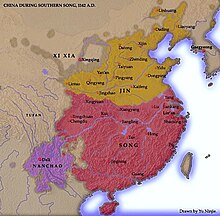
| Jin dynasty | |||||||||||||||||
|---|---|---|---|---|---|---|---|---|---|---|---|---|---|---|---|---|---|
| Chinese name | |||||||||||||||||
| Chinese | 金朝 | ||||||||||||||||
| |||||||||||||||||
| Alternative Chinese proper name | |||||||||||||||||
| Chinese | 大金 | ||||||||||||||||
| Literal significant | Nifty Jin | ||||||||||||||||
| |||||||||||||||||
| Khitan name | |||||||||||||||||
| Khitan | Nik, Niku | ||||||||||||||||
Origin [edit]
By the 11th century, the Jurchens had become vassals of the Khitan rulers of the Liao dynasty. The Jurchens in the Yalu River region had been tributaries of Goryeo[ citation needed ] since the reign of Wang Geon, who called upon them during the wars of the Later Three Kingdoms period, only the Jurchens switched allegiance betwixt Liao and Goryeo multiple times out of expedience.[ citation needed ] They offered tribute to both courts out of political necessity and the attraction of cloth benefits.[9]
Wanyan Aguda [edit]
The Jin dynasty was created in modern Jilin and Heilongjiang past the Jurchen tribal chieftain Aguda in 1115. According to tradition, Aguda was a descendant of Hanpu. Aguda adopted the term for "gilded" every bit the name of his state, itself a translation of "Anchuhu" River, which meant "aureate" in Jurchen.[x] This river known equally Alachuke in Chinese, was a tributary of the Songhua River east of Harbin.[10] The Jurchens' early rulers were the Khitan-led Liao dynasty, which had held sway over modern north and northeast Cathay and the Mongolian Plateau, for several centuries. In 1121, the Jurchens entered into the Alliance Conducted at Sea with the Han-led Northern Vocal dynasty and agreed to jointly invade the Liao dynasty. While the Song armies faltered, the Jurchens succeeded in driving the Liao to Primal Asia. In 1125, after the expiry of Aguda, the Jin dynasty broke its alliance with the Song dynasty and invaded north China. When the Vocal dynasty reclaimed the Han-populated Xvi Prefectures, they were "fiercely resisted" past the Han Chinese population there who had previously been under Liao dominion, while when the Jurchens invaded that area, the Han Chinese did non oppose them at all and handed over the Southern Capital (nowadays-day Beijing, then known equally Yanjing) to them.[11] The Jurchens were supported by the anti-Song, Beijing-based noble Han clans.[12] The Han Chinese who worked for the Liao were viewed as hostile enemies past the Song dynasty.[13] Song Han Chinese also defected to the Jin.[xiv] One crucial mistake that the Song made during this joint attack was the removal of the defensive wood it originally built along the Song-Liao border. Because of the removal of this landscape barrier, in 1126/27, the Jin army marched apace across the North China Obviously to Bianjing (present-mean solar day Kaifeng).[fifteen] On 9 January 1127, the Jurchens ransacked the Imperial palaces in Kaifeng, the capital letter of the Northern Song dynasty, capturing both Emperor Qinzong and his father, Emperor Huizong, who had abdicated in panic in the confront of the Jin invasion. Post-obit the autumn of Bianjing, the succeeding Southern Song dynasty connected to fight the Jin dynasty for over a decade, somewhen signing the Treaty of Shaoxing in 1141, which chosen for the cession of all Song territories north of the Huai River to the Jin dynasty and the execution of Vocal full general Yue Fei in return for peace. The peace treaty was formally ratified on 11 Oct 1142 when a Jin envoy visited the Vocal court.[16]
Having conquered Kaifeng and occupied North Communist china, the Jin later deliberately chose earth equally its dynastic element and yellowish as its purple color. Co-ordinate to the theory of the V Elements (wuxing), the earth element follows the fire, the dynastic chemical element of the Vocal, in the sequence of elemental creation. Therefore, this ideological move shows that the Jin regarded the Vocal reign of China was officially over and themselves every bit the rightful ruler of Prc Proper.[17]
Migration due south [edit]
Later taking over Northern Red china, the Jin dynasty became increasingly sinicised. About three million people, half of them Jurchens, migrated southward into northern China over 2 decades, and this minority governed about thirty one thousand thousand people. The Jurchens were given land grants and organised into hereditary military units: 300 households formed a mouke (company) and vii–10 moukes formed a meng-an (battalion).[18] Many married Han Chinese, although the ban on Jurchen nobles marrying Han Chinese was non lifted until 1191. After Emperor Taizong died in 1135, the next three Jin emperors were grandsons of Aguda by three dissimilar princes. Emperor Xizong (r. 1135–1149) studied the classics and wrote Chinese poetry. He adopted Han Chinese cultural traditions, but the Jurchen nobles had the top positions.
Later in life, Emperor Xizong became an alcoholic and executed many officials for criticising him. He too had Jurchen leaders who opposed him murdered, even those in the Wanyan association. In 1149 he was murdered by a cabal of relatives and nobles, who fabricated his cousin Wanyan Liang the next Jin emperor. Because of the brutality of both his domestic and foreign policy, Wanyan Liang was posthumously demoted from the position of emperor. Consequently, historians take usually referred to him by the posthumous name "Prince of Hailing".[xix]
Rebellions in the n [edit]

| History of China | |||
|---|---|---|---|
| Ancient | |||
| Neolithic c. 8500 – c. 2070 BCE | |||
| Xia c. 2070 – c. 1600 BCE | |||
| Shang c. 1600 – c. 1046 BCE | |||
| Zhou c. 1046 – 256 BCE | |||
| Western Zhou | |||
| Eastern Zhou | |||
| Bound and Autumn | |||
| Warring States | |||
| Majestic | |||
| Qin 221–207 BCE | |||
| Han 202 BCE – 220 CE | |||
| Western Han | |||
| Xin | |||
| Eastern Han | |||
| Three Kingdoms 220–280 | |||
| Wei, Shu and Wu | |||
| Jin 266–420 | |||
| Western Jin | |||
| Eastern Jin | Sixteen Kingdoms | ||
| Northern and Southern dynasties 420–589 | |||
| Sui 581–618 | |||
| Tang 618–907 | |||
| 5 Dynasties and X Kingdoms 907–979 | Liao 916–1125 Western Xia 1038–1227 Jin 1115–1234 | ||
| Song 960–1279 | |||
| Northern Vocal | |||
| Southern Song | |||
| Yuan 1271–1368 | |||
| Ming 1368–1644 | |||
| Qing 1636–1912 | |||
| MODERN | |||
| Republic of People's republic of china on the mainland 1912–1949 | |||
| People's Republic of Prc 1949–present | |||
| Republic of China in Taiwan 1949–present | |||
| Related articles
| |||

Having usurped the throne, Wanyan Liang embarked on the program of legitimising his rule every bit an emperor of China. In 1153, he moved the empire'due south master capital from Huining Prefecture (south of present-solar day Harbin) to the former Liao capital, Yanjing (present-solar day Beijing).[19] [xx] Iv years after, in 1157, to emphasise the permanence of the move, he razed the nobles' residences in Huining Prefecture.[nineteen] [20] Wanyan Liang also reconstructed the onetime Song capital letter, Bianjing (nowadays-mean solar day Kaifeng), which had been sacked in 1127, making it the Jin's southern upper-case letter.[19]
Wanyan Liang likewise tried to suppress dissent by killing Jurchen nobles, executing 155 princes.[nineteen] To fulfil his dream of becoming the ruler of all People's republic of china, Wanyan Liang attacked the Southern Song dynasty in 1161. Meanwhile, 2 simultaneous rebellions erupted in Shangjing, at the Jurchens' old power base of operations: led by Wanyan Liang's cousin, soon-to-be crowned Wanyan Yong, and the other of Khitan tribesmen. Wanyan Liang had to withdraw Jin troops from southern Red china to quell the uprisings. The Jin forces were defeated past Song forces in the Battle of Caishi and Battle of Tangdao. With a depleted war machine forcefulness, Wanyan Liang failed to make headway in his attempted invasion of the Southern Song dynasty. Finally he was assassinated past his own generals in Dec 1161, due to his defeats. His son and heir was also assassinated in the capital.[19]
Although crowned in October, Wanyan Yong (Emperor Shizong) was non officially recognised as emperor until the murder of Wanyan Liang'southward heir.[19] The Khitan insurgence was not suppressed until 1164; their horses were confiscated so that the rebels had to take up farming. Other Khitan and Xi cavalry units had been incorporated into the Jin army. Because these internal uprisings had severely weakened the Jin'due south capacity to confront the Southern Vocal militarily, the Jin court under Emperor Shizong began negotiating for peace. The Treaty of Longxing (隆興和議) was signed in 1164 and ushered in more than forty years of peace between the 2 empires.
In the early 1180s, Emperor Shizong instituted a restructuring of 200 meng'an units to remove tax abuses and help Jurchens. Communal farming was encouraged. The Jin Empire prospered and had a large surplus of grain in reserve. Although learned in Chinese classics, Emperor Shizong was also known as a promoter of Jurchen linguistic communication and culture; during his reign, a number of Chinese classics were translated into Jurchen, the Imperial Jurchen Academy was founded, and the imperial examinations started to be offered in the Jurchen language.[21] Emperor Shizong's reign (1161–1189) was remembered by the posterity equally the time of comparative peace and prosperity, and the emperor himself was compared to the mythological rulers Yao and Shun. Poor Jurchen families in the southern Routes (Daming and Shandong) Battalion and Company households tried to live the lifestyle of wealthy Jurchen families and avert doing farming work by selling their ain Jurchen daughters into slavery and renting their state to Han tenants. The Wealthy Jurchens feasted and drank and wore damask and silk. The History of Jin (Jinshi) says that Emperor Shizong of Jin took note and attempted to halt these things in 1181.[22]
Emperor Shizong'south grandson, Emperor Zhangzong (r. 1189–1208), venerated Jurchen values, but he as well immersed himself in Han Chinese civilisation and married an ethnic Han Chinese woman. The Taihe Lawmaking of law was promulgated in 1201 and was based generally on the Tang Lawmaking. In 1207, the Southern Song dynasty attempted an invasion, but the Jin forces finer repulsed them. In the peace understanding, the Song dynasty had to pay higher annual indemnities and behead Han Tuozhou, the leader of the hawkish faction in the Song majestic court.
Fall of Jin [edit]
Starting from the early 13th century, the Jin dynasty began to feel the pressure of Mongols from the due north. Genghis Khan offset led the Mongols into Western Xia territory in 1205 and ravaged it four years later. In 1211 nearly 50,000 Mongol horsemen invaded the Jin Empire and began absorbing Khitan and Jurchen rebels. The Jin had a large army with 150,000 cavalry but abandoned the "western upper-case letter" Datong (see too the Battle of Yehuling). The next year the Mongols went n and looted the Jin "eastern capital", and in 1213 they besieged the "fundamental capital", Zhongdu (present-24-hour interval Beijing). In 1214 the Jin fabricated a humiliating treaty merely retained the capital. That summertime, Emperor Xuanzong abandoned the central capital and moved the government to the "southern capital" Kaifeng, making information technology the official seat of the Jin dynasty's ability.
In 1216, a hawkish faction in the Jin imperial court persuaded Emperor Xuanzong to attack the Song dynasty, but in 1219 they were defeated at the same place by the Yangtze River where Wanyan Liang had been defeated in 1161. The Jin dynasty now faced a two front war that they could not beget. Furthermore, Emperor Aizong won a succession struggle against his brother and then quickly ended the state of war and went dorsum to the majuscule. He made peace with the Tanguts of Western Xia, who had been centrolineal with the Mongols.

Cai Wenji returning to Han, Jin dynasty painting.
The Jurchen Jin emperor Wanyan Yongji's daughter, Jurchen Princess Qiguo was married to Mongol leader Genghis Khan in substitution for relieving the Mongol siege upon Zhongdu (Beijing) in the Mongol conquest of the Jin dynasty.[23]
Many Han Chinese and Khitans defected to the Mongols to fight against the Jin dynasty. Two Han Chinese leaders, Shi Tianze and Liu Heima ( 劉黑馬 ),[24] and the Khitan Xiao Zhala (蕭札剌) defected and allowable the three tumens in the Mongol army.[25] Liu Heima and Shi Tianze served Genghis Khan'south successor, Ögedei Khan.[26] Liu Heima and Shi Tianxiang led armies against Western Xia for the Mongols.[27] There were four Han tumens and three Khitan tumens, with each tumen consisting of ten,000 troops. The iii Khitan generals Shimo Beidi'er (石抹孛迭兒), Tabuyir (塔不已兒), and Xiao Zhongxi ( 蕭重喜 ; Xiao Zhala'south son) commanded the three Khitan tumens and the four Han generals Zhang Rou ( 張柔 ), Yan Shi ( 嚴實 ), Shi Tianze and Liu Heima allowable the 4 Han tumens under Ögedei Khan.[28] [29] [30] [31] [ better source needed ]
Shi Tianze was a Han Chinese who lived nether Jin dominion. Inter-ethnic matrimony betwixt Han Chinese and Jurchens became common at this time. His male parent was Shi Bingzhi (史秉直). Shi Bingzhi married a Jurchen woman (surname Nahe) and a Han Chinese woman (surname Zhang); information technology is unknown which of them was Shi Tianze's female parent.[32] Shi Tianze was married to two Jurchen women, a Han Chinese woman, and a Korean woman, and his son Shi Gang was born to one of his Jurchen wives.[33] His Jurchen wives' surnames were Monian and Nahe, his Korean married woman'due south surname was Li, and his Han Chinese wife's surname was Shi.[32] Shi Tianze defected to the Mongol forces upon their invasion of the Jin dynasty. His son, Shi Gang, married a Keraite woman; the Keraites were Mongolified Turkic people and considered every bit part of the "Mongol nation".[33] [34] Shi Tianze, Zhang Rou, Yan Shi and other Han Chinese who served in the Jin dynasty and defected to the Mongols helped build the structure for the administration of the new Mongol state.[35]
The Mongols created a "Han Army" ( 漢軍 ) out of defected Jin troops, and some other army out of defected Vocal troops chosen the "Newly Submitted Army" ( 新附軍 ).[36]
Genghis Khan died in 1227 while his armies were attacking Western Xia. His successor, Ögedei Khan, invaded the Jin dynasty again in 1232 with aid from the Southern Song dynasty. The Jurchens tried to resist; just when the Mongols besieged Kaifeng in 1233, Emperor Aizong fled s to the city of Caizhou. A Song–Mongol centrolineal army surrounded the uppercase, and the next year Emperor Aizong committed suicide by hanging himself to avert being captured in the Mongols besieged Caizhou, ending the Jin dynasty in 1234.[nineteen] The territory of the Jin dynasty was to be divided between the Mongols and the Vocal dynasty. All the same, due to lingering territorial disputes, the Vocal dynasty and the Mongols eventually went to war with one another over these territories.
In Empire of The Steppes, René Grousset reports that the Mongols were always amazed at the valour of the Jurchen warriors, who held out until seven years after the death of Genghis Khan.
Armed services [edit]

Contemporary Chinese writers ascribed Jurchen success in overwhelming the Liao and Northern Vocal dynasties mainly to their cavalry. Already during Aguda'southward rebellion against the Liao dynasty, all Jurchen fighters were mounted. It was said that the Jurchen cavalry tactics were a carryover from their hunting skills.[37] Jurchen horsemen were provided with heavy armor; on occasions, they would apply a team of horses fastened to each other with chains (Guaizi Ma).[37]
As the Liao dynasty vicious apart and the Song dynasty retreated across the Yangtze, the army of the new Jin dynasty absorbed many soldiers who formerly fought for the Liao or Song dynasties.[37] The new Jin empire adopted many of the Song war machine's weapons, including various machines for siege warfare and artillery. In fact, the Jin military'due south utilise of cannons, grenades, and even rockets to defend besieged Kaifeng against the Mongols in 1233 is considered the first e'er battle in homo history in which gunpowder was used effectively, fifty-fifty though information technology failed to foreclose the eventual Jin defeat.[37]
On the other paw, the Jin war machine was not particularly adept at naval warfare. Both in 1129–30 and in 1161 Jin forces were defeated by the Southern Song navies when trying to cantankerous the Yangtze River into the cadre Southern Song territory (see Battle of Tangdao and Battle of Caishi), even though for the latter campaign the Jin had equipped a large navy of their own, using Han Chinese shipbuilders and even Han Chinese captains who had defected from the Southern Song.[37]
In 1130, the Jin army reached Hangzhou and Ningbo in southern Communist china. But heavy Chinese resistance and the geography of the area halted the Jin advance, and they were forced to retreat and withdraw, and they had not been able to escape the Song navy when trying to return until they were directed by a Han Chinese defector who helped them escape in Zhenjiang. Southern China was then cleared of the Jurchen forces.[38] [39]
The Jin war machine was organised through the meng-an mou-k'o organization, which seemed to exist similar to the afterwards Eight Banners of the Qing dynasty. Meng-an is from the Mongol word for thou, mingghan (see Military of the Yuan dynasty) while mou-k'o means clan or tribe. Groups of 50 households known every bit p'u-li-yen were grouped together equally a mou-k'o, while seven to ten mou-k'o formed a meng-an, and several meng-an were grouped into a wanhu, Chinese for Ten Yard Households. This was not simply a war machine structure merely besides grouped all Jurchen households for economic and administrative functions. Khitans and Han Chinese soldiers who had defected to the Jin dynasty were as well assigned into their own meng-an. All male person members of the households were required to serve in the military; the servants of the household would serve as auxiliaries to escort their masters in battle. The numbers of Han Chinese soldiers in the Jin armies seemed to be very significant.[40]
Jin Peachy Wall [edit]
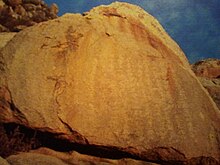
"Great Aureate Central State O-Giao Jeo-Shio" (1196), found in at present Mongolia.
In society to prevent incursion from the Mongols, a large structure program was launched. The records bear witness that ii of import sections of the Great Wall were completed by the Jurchens.
The Great Wall as constructed by the Jurchens differed from the previous dynasties. Known as the Border Fortress or the Purlieus Ditch of the Jin, it was formed by excavation ditches within which lengths of wall were congenital. In some places subsidiary walls and ditches were added for extra forcefulness. The structure was started in about 1123 and completed past about 1198. The two sections attributable to the Jin dynasty are known equally the Old Mingchang Walls and New Dandy Walls, together stretching more than than two,000 kilometres in length.[41]
Authorities [edit]
The government of the Jin dynasty merged Jurchen community with institutions adopted from the Liao and Song dynasties.[42] The pre-dynastic Jurchen authorities was based on the quasi-egalitarian tribal council.[43] Jurchen society at the fourth dimension did non take a strong political hierarchy. The Shuo Fu (說郛) records that the Jurchen tribes were not ruled past central authorisation and locally elected their chieftains.[42] Tribal customs were retained later on Aguda united the Jurchen tribes and formed the Jin dynasty, coexisting alongside more centralised institutions.[44] The Jin dynasty had five capitals, a practice they adopted from the Balhae and the Liao.[45] The Jin had to overcome the difficulties of controlling a multicultural empire equanimous of territories one time ruled by the Liao and Northern Song. The solution of the early Jin regime was to establish split up authorities structures for unlike indigenous groups.[46]
Culture [edit]
Considering the Jin had few contacts with its southern neighbor the Song, different cultural developments took identify in both states. Inside Confucianism, the "Learning of the Way" that developed and became orthodox in Song did not take root in Jin. Jin scholars put more than emphasis on the piece of work of northern Song scholar and poet Su Shi (1037–1101) than on Zhu Eleven's (1130–1200) scholarship, which constituted the foundation of the Learning of the Way.[47]
The Jin pursued a revival of Tang dynasty urban design with architectural projects in Kaifeng and Zhongdu (mod Beijing), building for instance a bell belfry and pulsate belfry to announce the night curfew (which was revived after existence abolished nether the Song).[48] The Jurchens followed Khitan precedent of living in tents amongst the Chinese-fashion architecture, which were in turn based on the Song dynasty Kaifeng model.[49]

A significant co-operative of Taoism chosen the Quanzhen School was founded under the Jin by Wang Zhe (1113–1170), a Han Chinese man who founded formal congregations in 1167 and 1168. Wang took the nickname of Wang Chongyang (Wang "Double Yang") and the disciples he took were retrospectively known as the "seven patriarchs of Quanzhen". The flourishing of ci poetry that characterized Jin literature was tightly linked to Quanzhen, every bit two-thirds of the ci poesy written in Jin times was equanimous by Quanzhen Taoists.
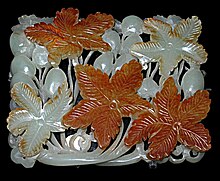

Chinese gilded plates and a chalice from the Jin Dynasty's Zhongdu.
The Jin state sponsored an edition of the Taoist Catechism that is known as the Precious Canon of the Mysterious Metropolis of the Great Jin (Da Jin Xuandu baozang 大金玄都寶藏). Based on a smaller version of the Canon printed by Emperor Huizong (r. 1100–1125) of the Song dynasty, it was completed in 1192 under the direction and back up of Emperor Zhangzong (r. 1190–1208).[fifty] In 1188, Zhangzong's grandfather and predecessor Shizong (r. 1161–1189) had ordered the woodblocks for the Song Canon transferred from Kaifeng (the onetime Northern Song capital that had now get the Jin "Southern Capital letter") to the Central Majuscule's "Abbey of Celestial Perpetuity" or Tianchang guan 天長觀, on the site of what is at present the White Cloud Temple in Beijing.[50] Other Daoist writings were also moved at that place from another abbey in the Cardinal Upper-case letter.[50] Zhangzong instructed the abbey's superintendent Sun Mingdao 孫明道 and ii civil officials to prepare a complete Canon for printing.[50] After sending people on a "nationwide search for scriptures" (which yielded 1,074 fascicles of text that was non included in the Huizong edition of the Canon) and securing donations for press, in 1192 Dominicus Mingdao proceeded to cut the new woodblocks.[51] The terminal print consisted of 6,455 fascicles.[52] Though the Jin emperors occasionally offered copies of the Catechism as gifts, not a single fragment of it has survived.[52]
A Buddhist Catechism or "Tripitaka" was also produced in Shanxi, the same place where an enhanced version of the Jin-sponsored Taoist Canon would be reprinted in 1244.[53] The project was initiated in 1139 past a Buddhist nun named Cui Fazhen, who swore (and allegedly "broke her arm to seal the oath") that she would heighten the necessary funds to brand a new official edition of the Canon printed past the Northern Vocal.[54] Completed in 1173, the Jin Tripitaka counted most vii,000 fascicles, "a major achievement in the history of Buddhist private printing."[54] Information technology was further expanded during the Yuan.[54]
Buddhism thrived during the Jin, both in its relation with the majestic court and in society in full general.[55] Many sutras were also carved on stone tablets.[56] The donors who funded such inscriptions included members of the Jin imperial family, loftier officials, common people, and Buddhist priests.[56] Some sutras take only survived from these carvings, which are thus highly valuable to the study of Chinese Buddhism.[56] At the same time, the Jin court sold monk certificates for revenue. This practise was initiated in 1162 by Shizong to fund his wars, and stopped three years subsequently when war was over.[57] His successor Zhanzong used the same method to heighten military funds in 1197 and i year later to enhance money to fight famine in the Western Majuscule.[57] The aforementioned practice was used again in 1207 (to fight the Song and more dearth) likewise as under the reigns of emperors Weishao (r. 1209–1213) and Xuanzong (r. 1213–1224) to fight the Mongols.[58]
Listing of emperors [edit]
| Temple proper noun | Posthumous proper noun1 | Jurchen proper name | Chinese proper noun | Years of reign | Era proper noun(s) and Years |
|---|---|---|---|---|---|
| Taizu (太祖) | Wuyuan (武元) | Aguda (阿骨打) | Min (旻) | 1115–1123 | Shouguo (收國; 1115–1116) Tianfu (天輔; 1117–1123) |
| Taizong (太宗) | Wenlie (文烈) | Wuqimai (吳乞買) | Sheng (晟) | 1123–1135 | Tianhui (天會; 1123–1135) |
| Xizong (熙宗) | Xiaocheng (孝成) | Hela (合剌) | Dan (亶) | 1135–1149 | Tianhui (天會; 1135–1138) Tianjuan (天眷; 1138–1141) Huangtong (皇統; 1141–1149) |
| None | – | Digunai (迪古乃) | Liang (亮) | 1149–1161 | Tiande (天德, 1149–1153) Zhenyuan (貞元; 1153–1156) Zhenglong (正隆; 1156–1161) |
| Shizong (世宗) | Renxiao (仁孝) | Wulu (烏祿) | Yong (雍) | 1161–1189 | Dading (大定; 1161–1189) |
| Zhangzong 章宗 | Guangxiao (光孝) | Madage (麻達葛) | Jing (璟) | 1189–1208 | Mingchang (明昌; 1190–1196) Cheng'an (承安; 1196–1200) Taihe (泰和; 1200–1208) |
| None | – | Unknown | Yongji (永濟) | 1208–1213 | Da'an (大安; 1209–1212) Chongqing (崇慶; 1212–1213) Zhining (至寧; 1213) |
| Xuanzong 宣宗 | Shengxiao (聖孝) | Wudubu (吾睹補) | Xun (珣) | 1213–1224 | Zhenyou (貞祐; 1213–1217) Xingding (興定; 1217–1222) Yuanguang (元光; 1222–1224) |
| Aizong (哀宗, official) Zhuangzong (莊宗, unofficial) Minzong (閔宗, unofficial) Yizong (義宗, unofficial) | None | Ningjiasu (寧甲速) | Shouxu (守緒) | 1224–1234 | Zhengda (正大; 1224–1232) Kaixing (開興; 1232) Tianxing (天興; 1232–1234) |
| None | None | Hudun (呼敦) | Chenglin (承麟) | 1234 | Shengchang (盛昌; 1234) |
| i: For full posthumous names, see the articles for individual emperors. | |||||
Emperors family tree [edit]
| Emperors family tree | |||||||||||||||||||||||||||||||||||||||||||||||||||||||||||||||||||||||||||||||||||||||||||||||||||||||||||||||||||||||||||||||||||||||||||||||||||||||||||||||||||||||||||||||||||||||||||||||||||||||||||||||||||||||||||||||||||||||||||||||||||||||||||||||||||||||||||||||||||||||||||||||||||||||||||||||||||||||||||||||||||||||||||||||||||||||||||||||||||||||||||||||||||||||||||||||||||||||||||||||||||||||||||||||||||||||||||||||||||||||||||||||||||||||||||||||||||||||||||||||||||||||||||||||||||||||||||||||||||||||||||||||||||||||||||||||||||||||||||||||||||||||||||||||||||||||||||||||||||||||||||||||||||||||||||||||||||||||||||||||||||||||||||||||||||||||||||||||||||||||||||||||||||||||||||||||||||||||||||||||||||||||||||||||||||||||||||||||||||||||||||||||||||||||||||||||||||||||||||||||||||||||||||||||||||||||||||||||||||||||||||||||||||||||||||||||||||||||||||||||||||||||||||||||||||||||||||||||||||||||||||||||||||||||||||||||||||||||||||||||||||||||||||||||||||||||||||||||||||||||
|---|---|---|---|---|---|---|---|---|---|---|---|---|---|---|---|---|---|---|---|---|---|---|---|---|---|---|---|---|---|---|---|---|---|---|---|---|---|---|---|---|---|---|---|---|---|---|---|---|---|---|---|---|---|---|---|---|---|---|---|---|---|---|---|---|---|---|---|---|---|---|---|---|---|---|---|---|---|---|---|---|---|---|---|---|---|---|---|---|---|---|---|---|---|---|---|---|---|---|---|---|---|---|---|---|---|---|---|---|---|---|---|---|---|---|---|---|---|---|---|---|---|---|---|---|---|---|---|---|---|---|---|---|---|---|---|---|---|---|---|---|---|---|---|---|---|---|---|---|---|---|---|---|---|---|---|---|---|---|---|---|---|---|---|---|---|---|---|---|---|---|---|---|---|---|---|---|---|---|---|---|---|---|---|---|---|---|---|---|---|---|---|---|---|---|---|---|---|---|---|---|---|---|---|---|---|---|---|---|---|---|---|---|---|---|---|---|---|---|---|---|---|---|---|---|---|---|---|---|---|---|---|---|---|---|---|---|---|---|---|---|---|---|---|---|---|---|---|---|---|---|---|---|---|---|---|---|---|---|---|---|---|---|---|---|---|---|---|---|---|---|---|---|---|---|---|---|---|---|---|---|---|---|---|---|---|---|---|---|---|---|---|---|---|---|---|---|---|---|---|---|---|---|---|---|---|---|---|---|---|---|---|---|---|---|---|---|---|---|---|---|---|---|---|---|---|---|---|---|---|---|---|---|---|---|---|---|---|---|---|---|---|---|---|---|---|---|---|---|---|---|---|---|---|---|---|---|---|---|---|---|---|---|---|---|---|---|---|---|---|---|---|---|---|---|---|---|---|---|---|---|---|---|---|---|---|---|---|---|---|---|---|---|---|---|---|---|---|---|---|---|---|---|---|---|---|---|---|---|---|---|---|---|---|---|---|---|---|---|---|---|---|---|---|---|---|---|---|---|---|---|---|---|---|---|---|---|---|---|---|---|---|---|---|---|---|---|---|---|---|---|---|---|---|---|---|---|---|---|---|---|---|---|---|---|---|---|---|---|---|---|---|---|---|---|---|---|---|---|---|---|---|---|---|---|---|---|---|---|---|---|---|---|---|---|---|---|---|---|---|---|---|---|---|---|---|---|---|---|---|---|---|---|---|---|---|---|---|---|---|---|---|---|---|---|---|---|---|---|---|---|---|---|---|---|---|---|---|---|---|---|---|---|---|---|---|---|---|---|---|---|---|---|---|---|---|---|---|---|---|---|---|---|---|---|---|---|---|---|---|---|---|---|---|---|---|---|---|---|---|---|---|---|---|---|---|---|---|---|---|---|---|---|---|---|---|---|---|---|---|---|---|---|---|---|---|---|---|---|---|---|---|---|---|---|---|---|---|---|---|---|---|---|---|---|---|---|---|---|---|---|---|---|---|---|---|---|---|---|---|---|---|---|---|---|---|---|---|---|---|---|---|---|---|---|---|---|---|---|---|---|---|---|---|---|---|---|---|---|---|---|---|---|---|---|---|---|---|---|---|---|---|---|---|---|---|---|---|---|---|---|---|---|---|---|---|---|---|---|---|---|---|---|---|---|---|---|---|---|---|---|---|---|---|---|---|---|---|---|---|---|---|---|---|---|---|---|---|---|---|---|---|---|---|---|---|---|---|---|---|---|---|---|---|---|---|---|---|---|---|---|---|---|---|---|---|---|---|---|---|---|---|---|---|---|---|---|---|---|---|---|---|---|---|---|---|---|---|---|---|---|---|---|---|---|---|---|---|---|---|---|---|---|---|---|---|---|---|---|---|---|---|---|---|---|---|---|---|---|---|---|---|---|---|---|---|---|---|---|---|---|---|---|---|---|---|---|---|---|---|---|---|---|---|---|---|---|---|---|---|---|---|---|---|---|---|---|---|---|---|---|---|---|---|---|---|---|---|---|---|---|---|---|---|---|---|---|---|---|---|---|---|---|---|---|---|---|---|---|---|---|---|---|---|---|---|---|---|---|---|---|---|---|---|---|---|---|---|---|---|---|---|---|---|---|---|---|---|---|---|---|---|---|---|---|---|---|---|---|---|---|---|---|---|---|---|---|---|---|---|---|---|---|---|---|---|---|---|---|---|---|---|---|---|---|---|---|---|---|---|---|---|---|---|---|---|---|---|---|---|---|---|---|---|---|---|---|---|---|---|---|---|---|---|---|---|---|---|---|---|---|---|---|---|---|---|---|---|---|---|---|---|---|---|---|---|---|---|---|---|
| |||||||||||||||||||||||||||||||||||||||||||||||||||||||||||||||||||||||||||||||||||||||||||||||||||||||||||||||||||||||||||||||||||||||||||||||||||||||||||||||||||||||||||||||||||||||||||||||||||||||||||||||||||||||||||||||||||||||||||||||||||||||||||||||||||||||||||||||||||||||||||||||||||||||||||||||||||||||||||||||||||||||||||||||||||||||||||||||||||||||||||||||||||||||||||||||||||||||||||||||||||||||||||||||||||||||||||||||||||||||||||||||||||||||||||||||||||||||||||||||||||||||||||||||||||||||||||||||||||||||||||||||||||||||||||||||||||||||||||||||||||||||||||||||||||||||||||||||||||||||||||||||||||||||||||||||||||||||||||||||||||||||||||||||||||||||||||||||||||||||||||||||||||||||||||||||||||||||||||||||||||||||||||||||||||||||||||||||||||||||||||||||||||||||||||||||||||||||||||||||||||||||||||||||||||||||||||||||||||||||||||||||||||||||||||||||||||||||||||||||||||||||||||||||||||||||||||||||||||||||||||||||||||||||||||||||||||||||||||||||||||||||||||||||||||||||||||||||||||||||
Encounter also [edit]
- Eastern Xia
- Jurchen Jin emperors family tree
- Korean–Jurchen border conflicts
- Timeline of the Jin–Song Wars
References [edit]
Citations [edit]
- ^ Turchin, Peter; Adams, Jonathan M.; Hall, Thomas D (December 2006). "East-Due west Orientation of Historical Empires" (PDF). Journal of Earth-Systems Research. 12 (2): 219–229. doi:x.5195/JWSR.2006.369. ISSN 1076-156X. Archived from the original (PDF) on 22 Feb 2007. Retrieved 12 August 2010.
- ^ Rein Taagepera (September 1997). "Expansion and Contraction Patterns of Big Polities: Context for Russia". International Studies Quarterly. 41 (three): 497. doi:10.1111/0020-8833.00053. JSTOR 2600793.
- ^ Twitchett 1994, p. 40. sfn error: no target: CITEREFTwitchett1994 (assistance)
- ^ "Jin". Random House Webster'due south Unabridged Dictionary.
- ^ Lipschutz, Leonard (1 August 2000). Century-Past-Century: A Summary of World History. iUniverse. p. 59. ISBN9780595125784 . Retrieved 28 June 2014.
- ^ Zhao 2006, p. seven.
- ^ Zhao 2006, p. 6.
- ^ Zhao 2006, p. 24.
- ^ Breuker 2010, pp. 220–221.
- ^ a b Franke 1994, p. 221.
- ^ Franke & Twitchett 1994, p. 39.
- ^ Tillman 1995a, pp. 28–.
- ^ Elliott, Mark (2012). "8. Hushuo The Northern Other and the Naming of the Han Chinese" (PDF). In Mullaney, Tomhas S.; Leibold, James; Gros, Stéphane; Bussche, Eric Vanden (eds.). Critical Han Studies The History, Representation, and Identity of Red china's Majority. University of California Press. p. 186.
- ^ Gernet 1996, pp. 358–.
- ^ Chen, Yuan Julian (2018). "Borderland, Fortification, and Forestation: Defensive Woodland on the Song–Liao Border in the Long Eleventh Century". Periodical of Chinese History. two (2): 313–334. doi:10.1017/jch.2018.7. ISSN 2059-1632.
- ^ Robert Hymes (2000). John Stewart Bowman (ed.). Columbia Chronologies of Asian History and Culture . Columbia Academy Press. p. 34. ISBN978-0-231-11004-4.
- ^ Chen, Yuan Julian (2014). "Legitimation Discourse and the Theory of the Five Elements in Regal China". Journal of Song-Yuan Studies. 44 (ane): 325–364. doi:10.1353/sys.2014.0000.
- ^ Mark C. Elliot (2001). The Manchu Way: The 8 banners and ethnic identity in belatedly imperial China. Stanford, California: Stanford Academy Printing. p. lx.
- ^ a b c d eastward f grand h Beck, Sanderson. "Liao, Xi Xia, and Jin Dynasties 907–1234". China 7 BC To 1279.
- ^ a b Tao (1976), p. 44
- ^ Tao (1976), Chapter 6. "The Jurchen Movement for Revival", pp. 69–83
- ^ Schneider, Julia. "The Jin Revisited: New Assessment of Jurchen Emperors." Periodical of Song-Yuan Studies, no. 41, 2011, p. 389. JSTOR, https://www.jstor.org/stable/23496214?seq=47#metadata_info_tab_contents. Accessed 17 Dec. 2020.
- ^ Broadbridge, Anne F. (2018). Women and the Making of the Mongol Empire (illustrated ed.). Cambridge University Press. p. 94. ISBN978-1108636629.
- ^ Collectif (2002). Revue bibliographique de sinologie 2001. Éditions de fifty'École des hautes études en sciences sociales. p. 147.
- ^ May, Timothy Michael (2004). The Mechanics of Conquest and Governance: The Rise and Expansion of the Mongol Empire, 1185–1265. University of Wisconsin—Madison. p. 50.
- ^ Schram, Stuart Reynolds (1987). Foundations and Limits of State Power in Red china. European Scientific discipline Foundation by School of Oriental and African Studies, University of London. p. 130.
- ^ Gary Seaman; Daniel Marks (1991). Rulers from the steppe: state germination on the Eurasian periphery. Ethnographics Press, Center for Visual Anthropology, University of Southern California. p. 175.
- ^ 胡小鹏 (2001). "窝阔台汗己丑年汉军万户萧札剌考辨--兼论金元之际的汉地七万户" [A Report of XIAO Zha-la the Han Army Commander of 10,000 Families in the Twelvemonth of 1229 during the Period of Khan (O)gedei]. 西北师大学报(社会科学版) PKUCSSCI [Journal of Northwest Normal University (Social Sciences)] (in Chinese). 38 (six). doi:ten.3969/j.issn.1001-9162.2001.06.008. Archived from the original on 2 Baronial 2016. Retrieved iii May 2016.
- ^ "窝阔台汗己丑年汉军万户萧札剌考辨--兼论金元之际的汉地七万户-国家哲学社会科学学术期刊数据库".
- ^ https://zh.wikisource.org/zh-hant/新元史/卷146
- ^ "作品相关 第二十九章 大库里台. 本章出自《草原特种兵》" [Chapter 29 Big Back-scratch Terrace. This chapter is from Grassland Special Forces] (in Chinese). Archived from the original on iv March 2016. Retrieved 3 May 2016.
- ^ a b Igor de Rachewiltz, ed. (1993). In the Service of the Khan: Eminent Personalities of the Early Mongol-Yüan Period (1200–1300). Otto Harrassowitz Verlag. p. 41.
- ^ a b J. Ganim; S. Legassie, eds. (2013). Cosmopolitanism and the Middle Ages. Springer. p. 47.
- ^ Watt, James C. Y. (2010). The Earth of Khubilai Khan: Chinese Fine art in the Yuan Dynasty. Metropolitan Museum of Art. p. 14.
- ^ Chan, Hok-Lam (1997). "A Recipe to Qubilai Qa'an on Governance: The Example of Chang Te-hui and Li Chih". Periodical of the Royal Asiatic Society. Cambridge University Press. seven (two): 257–83. doi:ten.1017/S1356186300008877.
- ^ Hucker, Charles O. (1985). A Dictionary of Official Titles in Imperial China. Stanford University Press. p. 66.
- ^ a b c d due east Tao (1976), Chapter 2. "The Rise of the Chin dynasty", pp. 21–24
- ^ Gernet (1996), p. 357. "Nanking and Hangchow were taken past assault in 1129 and in 1130 the Jürchen ventured equally far as Ning-po, in the n-eastern tip of Chekiang."
- ^ René Grousset (1970). The Empire of the Steppes: A History of Central Asia (reprint, illustrated ed.). Rutgers University Press. p. 137. ISBN978-0-8135-1304-1.
The emperor Kao-tsung had taken flight to Ningpo (and then known as Mingchow) and later to the port of Wenchow, south of Chekiang. From Nanking the Kin full general Wu-chu hastened in pursuit and captured Hangchow and Ningpo (stop of 1129 and showtime of 1130. However, the Kin army, consisting entirely of cavalry, had ventured too far into this China of the southward with its flooded lands, intersecting rivers, paddy fields and canals, and dense population which harassed and encircled it. We-chu, leader of the Kin troops, sought to render north but was halted by the Yangtze, now wide as a ocean and patrolled by Chinese flotillas. At concluding a traitor showed him how he might cantankerous the river near Chenkiang, east of Nanking (1130).
- ^ Franke 1994, pp. 273–277.
- ^ "Slap-up Wall of Jin Dynasty (1115–1234)". TravelChinaGuide.
- ^ a b Franke 1994, p. 265.
- ^ Franke 1994, pp. 265–266.
- ^ Franke 1994, p. 266.
- ^ Franke 1994, p. 270.
- ^ Franke 1994, p. 267.
- ^ Tillman 1995b, pp.[, page needed ], .
- ^ Robert South. Nelson, Margaret Olin (2003). Monuments and Memory, Made and Unmade. University of Chicago Printing. p. 119. ISBN9780226571584.
- ^ Toby Lincoln (2021). An Urban History of Communist china. Cambridge University Press. p. 89. ISBN9781107196421.
- ^ a b c d Boltz 2008, p. 291.
- ^ Boltz 2008, pp. 291–92.
- ^ a b Boltz 2008, p. 292.
- ^ Yao 1995, p. 174; Goossaert 2008, p. 916 (both Buddhist Canon and Daoist Catechism printed in Shanxi).
- ^ a b c Yao 1995, p. 174.
- ^ Yao 1995, p. 173.
- ^ a b c Yao 1995, p. 175.
- ^ a b Yao 1995, p. 161.
- ^ Yao 1995, pp. 161–62.
Sources [edit]
- Boltz, Judith (2008), "Da Jin Xuandu baozang 大金玄嘟寶藏", in Pregadio, Fabrizio (ed.), The Encyclopedia of Taoism, London and New York: Routledge, pp. 291–92, ISBN978-0-7007-1200-7 .
- Breuker, Remco E. (2010), Establishing a Pluralist Guild in Medieval Korea, 918-1170: History, Ideology and Identity in the Koryŏ Dynasty, vol. 1 of Brill'southward Korean Studies Library, Leiden: Brill, pp. 220-221, ISBN978-9004183254
- Franke, Herbert (1971), "Chin Dynastic History Project", Sung Studies Newsletter, 3 (3): 36–37, JSTOR 23497078 .
- Franke, Herbert (1994), "The Mentum dynasty", in Denis C. Twitchett; John Male monarch Fairbank (eds.), The Cambridge History of China: Volume six, Alien Regimes and Border States, 907–1368, Cambridge University Printing, pp. 215–320, ISBN978-0-521-24331-five
- Franke, Herbert; Twitchett, Denis C. (1994), "Introduction", in Denis C. Twitchett; John King Fairbank (eds.), The Cambridge History of Communist china: Volume 6, Alien Regimes and Border States, 907–1368, Cambridge University Printing, pp. 1–42, ISBN978-0-521-24331-five
- Gernet, Jacques (1996). A History of Chinese Civilization (2nd ed.). Cambridge University Printing. ISBN978-0-521-49781-7.
- Goossaert, Vincent (2008), "Song Defang 宋德方", in Pregadio, Fabrizio (ed.), The Encyclopedia of Taoism, London and New York: Routledge, pp. 915–16, ISBN978-0-7007-1200-7 .
- Schneider, Julia (2011), "The Jin Revisited: New Assessment of Jurchen Emperors", Journal of Song-Yuan Studies, 41 (41): 343–404, doi:10.1353/sys.2011.0030, hdl:1854/LU-2045182, JSTOR 23496214, S2CID 162237648
- Tao, Jing-shen (1976), The Jurchen in Twelfth-Century China , Academy of Washington Press, ISBN978-0-295-95514-8
- Tillman, Hoyt Cleveland (1995a). "An Overview of Chin History and Institutions". In Tillman, Hoyt Cleveland; West, Stephen H. (eds.). Red china Under Jurchen Rule: Essays on Chin Intellectual and Cultural History. SUNY Press. pp. 23–38. ISBN978-0-7914-2273-1.
- Tillman, Hoyt Cleveland (1995b), "Confucianism under the Chin and the Impact of Sung Confucian Tao-hsüeh", in Tillman, Hoyt Cleveland; West, Stephen H. (eds.), Cathay nether Jurchen Rule: Essays on Mentum Intellectual and Cultural History, SUNY Printing, pp. 71–114, ISBN978-0-7914-2273-1
- Twitchett, Denis C.; Fairbank, John King, eds. (1994), The Cambridge History of People's republic of china: Book six, Alien Regimes and Border States, 907–1368, Cambridge University Press, ISBN978-0-521-24331-5 , retrieved ten March 2014 (hardcover)
- Yao, Tao-chung (1995), "Buddhism and Taoism nether the Mentum", in Hoyt Cleveland Tillman; Stephen H. West (eds.), Cathay nether Jurchen Dominion: Essays on Chin Intellectual and Cultural History, Albany, NY: SUNY Press, pp. 145–80, ISBN978-0-7914-2274-8
- Zhao, Gang (2006), "Reinventing China: Imperial Qing Ideology and the Rise of Modern Chinese National Identity in the Early Twentieth Century", Modern China, 32 (1): 3–xxx, doi:10.1177/0097700405282349, JSTOR 20062627, S2CID 144587815
External links [edit]
-
 Media related to Jin Dynasty (1115-1234) at Wikimedia Eatables
Source: https://en.wikipedia.org/wiki/Jin_dynasty_%281115%E2%80%931234%29
0 Response to "koryo built a wall at the yalu river in the eleventh century to help keep out what enemy?"
Post a Comment